Description
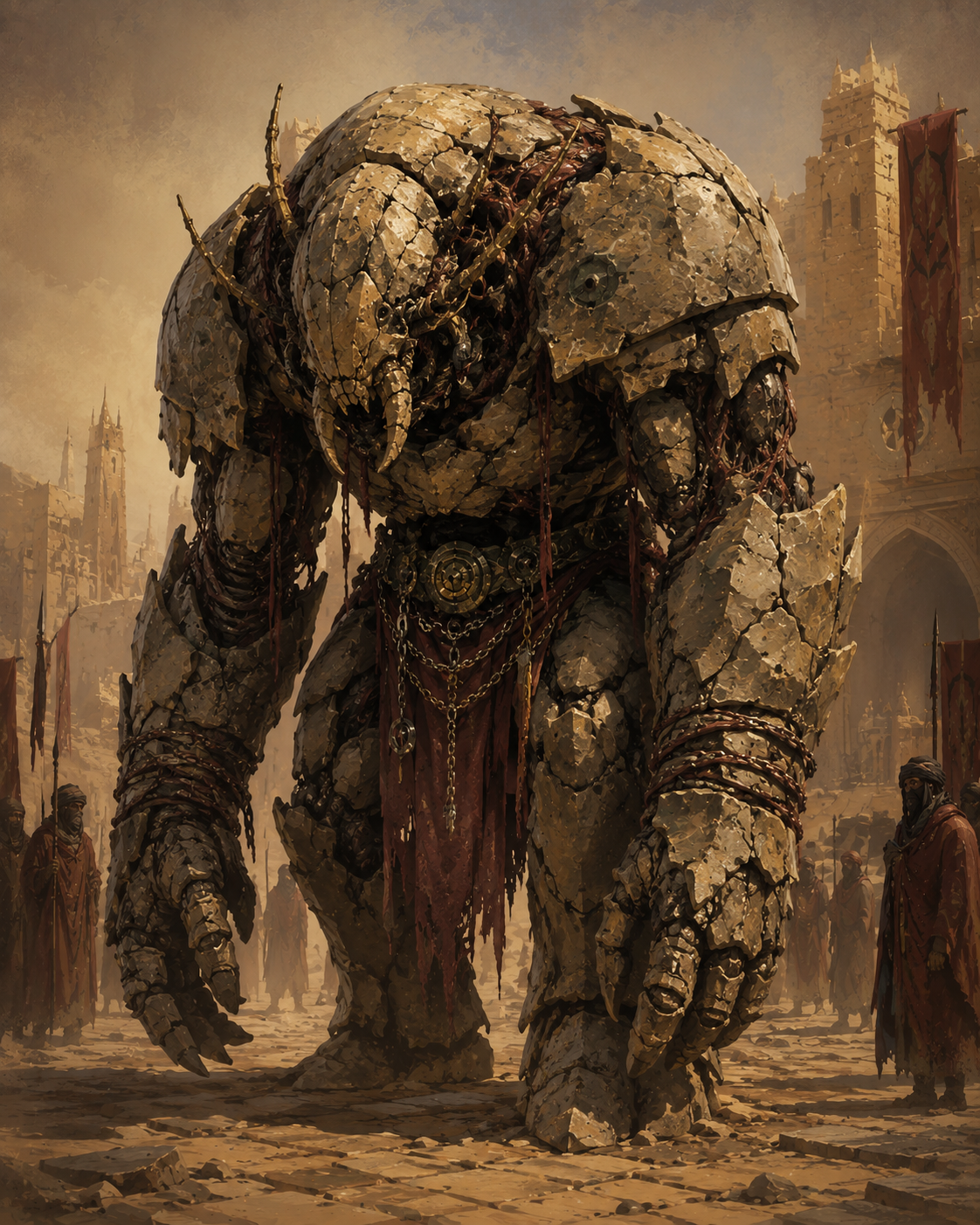
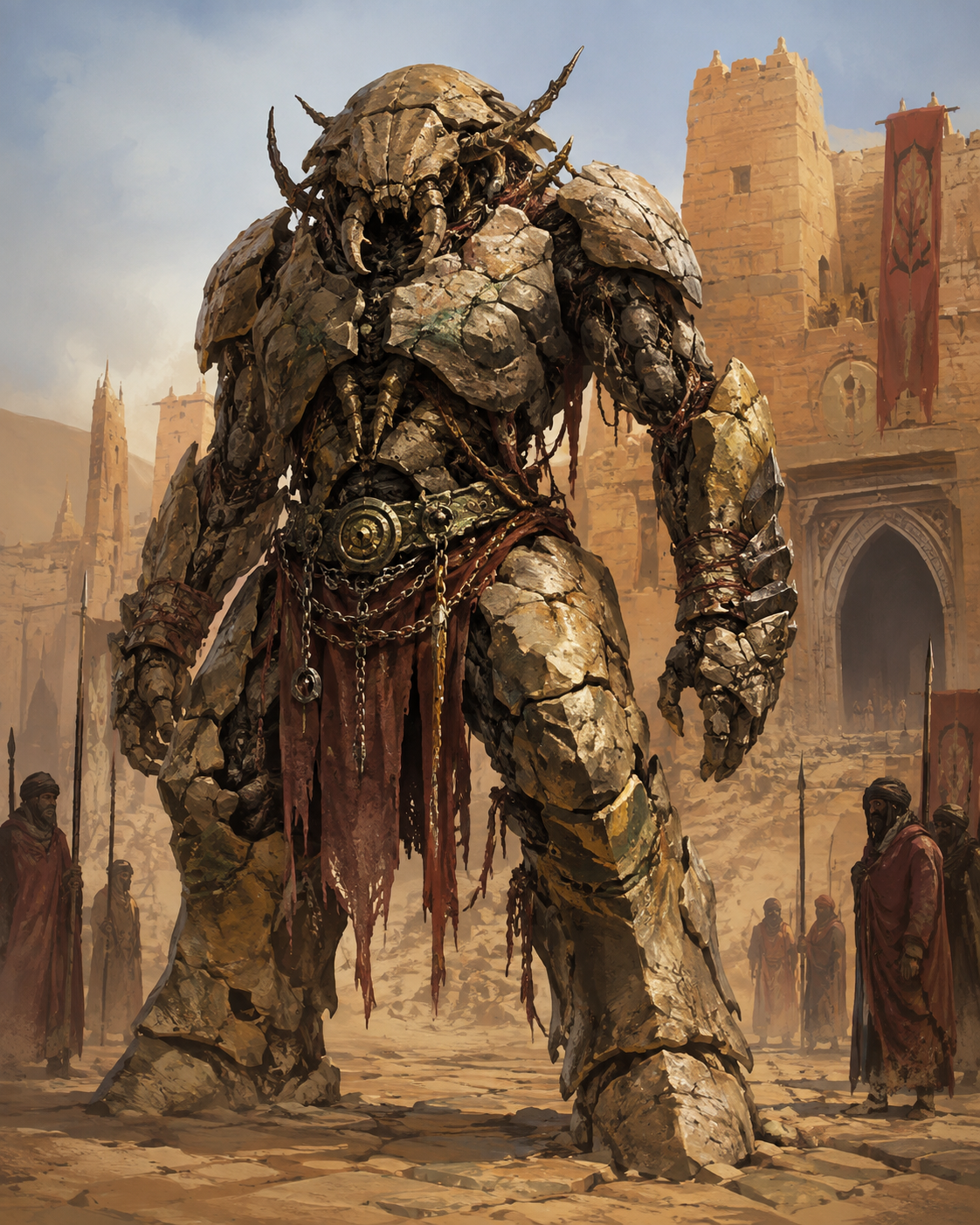
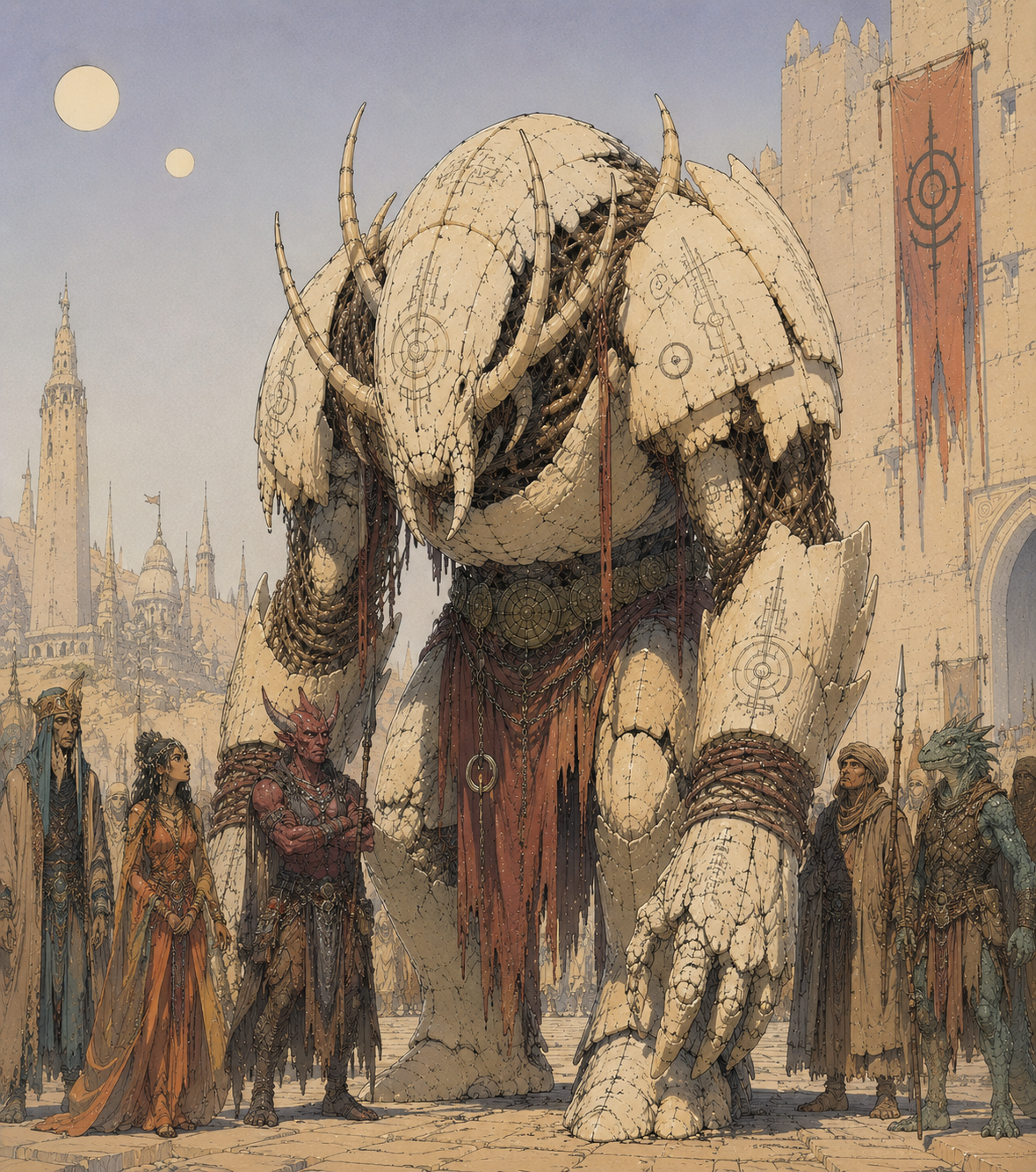
Forged in the Hearth of Tarkes, Revenants are hulking constructs born from an unholy union of human sacrifice and the fungal-animated carcass of a giant zombie beetle. Through defiling sorcery and concentrated Miraj, human flesh, bone, chitin, and the dead beetle are fused together and remade into something neither human nor beast, yet bearing remnants of both.
The secret of their creation belongs to the viziers of the self-proclaimed Death Dealer and Throne, Harkol Aum. Revenants serve throughout Harkol’s armies as tireless soldiers and engines of war, requiring neither food, water, nor rest to march across the wastes. Harkol has no qualms about selling his creations to neighboring city-states, rival armies, wealthy patrons, or virtually anyone capable of paying the considerable price demanded by the Hearth.
Every Revenant requires a human sacrifice. Harkol’s viziers maintain that these sacrifices are willing volunteers drawn from Tarkes’ standing army, honored with the opportunity to serve their city beyond death. Few believe them. Prisoners of Harkol’s regime, captured enemies, condemned criminals, and citizens disappeared from Tarkes’ remarkably vagrant-free streets are all rumored to have found their way into the fires of the Hearth.
Whatever enters the Hearth does not emerge unchanged. The excruciating forging scours away nearly every memory of the sacrificed person’s former life, but it does not erase them completely. Habits, preferences, fears, fixations, and other fragments of personality inexplicably survive. A Revenant may hate the taste of a food it can no longer eat, recoil from a stranger it cannot remember, or feel an inexplicable affection for a place it has never knowingly visited. Rarely, even a name survives.
Nor is the human sacrifice the only thing to leave an imprint. Something of the zombie beetle’s primal nature survives the forging as well. Violence and death can awaken disturbing instincts within even the most disciplined Revenant, causing the construct to erupt into an uncontrollable frenzy. Whether these impulses belong to the dead beetle, the fungus that once animated its carcass, or something new born from their unnatural union is unknown.
Despite the horrors of their creation, Revenants are fully sentient beings with individual personalities, desires, and dispositions. Whether any part of the sacrificed person’s spirit truly survives within them is a matter of considerable dispute. Some Revenants consider themselves continuations of the people sacrificed to create them. Others regard that person as dead and themselves as something entirely new. The Hearth has offered no answers.
Newly forged Revenants are typically burdened with indentured servitude, their creators demanding recompense for the considerable expense of their own creation. Harkol’s lucrative trade has scattered Revenants throughout neighboring city-states, however, and their long lives provide ample opportunity to escape, purchase, earn, or otherwise obtain their freedom. Free Revenants can consequently be found wandering far beyond Tarkes, carrying with them whatever purpose they have chosen for themselves.
A Revenant’s appearance reflects the grotesque nature of its creation. Averaging nine feet tall and weighing nearly seven hundred pounds, they possess hulking humanoid forms of hardened chitin, bone, silt, gypsum, and other materials fused together during the forging. Their heavy exoskeleton serves as natural armor, while mandibles and other remnants of their beetle origins give them a distinctly inhuman visage. Unable to produce ordinary speech, Revenants approximate language through elaborate clicks, chitters, scrapes, and other sounds produced by their mandibles. Their words can be understood, but few would mistake the sound for a human voice.
No two Revenants are precisely alike. The condition of the beetle carcass, the materials cast into the Hearth, the hand of the viziers performing the ritual, and perhaps even the nature of the sacrificed person all leave subtle marks upon the finished creation. Their chitin varies in texture and coloration, their proportions differ, and some emerge bearing strange asymmetries or vestigial features whose purpose even their creators cannot explain.
Naming Conventions
Revenants emerge from the Hearth with little memory of the person sacrificed in their creation and rarely remember the name they once carried. Most are therefore given new names by their creators, handlers, comrades, or other Revenants. These names vary considerably, ranging from simple descriptive names and military sobriquets to names chosen from the many cultures through which Revenants pass.
Free Revenants sometimes discard the names given to them in Tarkes and choose their own, marking their independence with a new identity. Others retain their first name regardless of its origin, regarding it as belonging to the Revenant rather than the person sacrificed to create them.
On rare occasions, a name survives the forging. Whether it truly belonged to the sacrificed person or is merely another fragment conjured from a ruined memory is impossible to know. Some Revenants cling fiercely to such names. Others refuse them.
Examples include:
Ash, Cairn, Chitter, Flint, Grond, Husk, Kesh, Rattle, Scar, and Vek.
Characteristics
- Carrion Call: Something of the zombie beetle’s primal instincts survives the Revenant forging process, stirring violently in the presence of death. Revenants have the Berserk Edge. In addition to its normal triggers, whenever another character within Range Smarts is Incapacitated, the Revenant must make a Smarts roll or go Berserk. As usual, the Revenant may voluntarily fail this roll.
- Chitin Husk: Revenants have a hardened chitinous exoskeleton that provides +2 natural Armor. Worn armor does not stack with this natural Armor; use whichever Armor value is higher. Revenants cannot take the Armored Loincloth Edge.
- Construct: Revenants add +2 to recover from being Shaken, ignore one level of Wound modifiers, don’t eat, drink, or breathe, and are immune to disease and poison. Wounds must be mended via the Repair skill. Each attempt takes one hour per current Wound level and ignores the Golden Hour.
- Forged Colossus: Revenants start with a d6 in Strength and Vigor. This raises their maximum for Strength and Vigor to d12 + 1.
- Hulking: Owing to their large, lumbering size and exceptional weight, Revenants are poorly suited to feats of agility or subtle movement. They suffer a −2 penalty to Athletics and Stealth rolls.
- Inhuman Voice: Revenants have no vocal cords and replicate the sounds of spoken language using the chittering and clicking of their mandibles. Their speech sounds vaguely like language and can usually be understood, but has a distinctly unnatural quality. They suffer −2 to Language rolls and to Persuasion or Performance rolls that rely on speech. Additionally, they cannot take Arcane Background (Sorcery), as they cannot articulate the precise incantations necessary for spellcasting.
- Memory Scoured: The creation process strips Revenants of their former memories, but fragments of their old personality often remain. Revenants have the Quirk (Minor) Hindrance, representing an inexplicable habit, preference, aversion, fixation, or other remnant of the person sacrificed during their creation. Revenants suffer a −2 penalty to Common Knowledge rolls.
- Size 1: Revenants average about nine feet tall and weigh roughly 700 pounds. Their Size and Toughness increase by +1, and their maximum Strength increases another step to d12+2.
- Slow: Due to their lumbering size Revenant’s Pace is reduced to 5 and their running die to a d4.
- Unusual Size: Revenants are particularly large compared to other ancestries. They subtract 2 from Trait rolls when using equipment that wasn’t specifically designed for Revenants and cannot wear normal-sized armor or clothing. Equipment and clothing designed for Revenants cost double the listed price.
Media