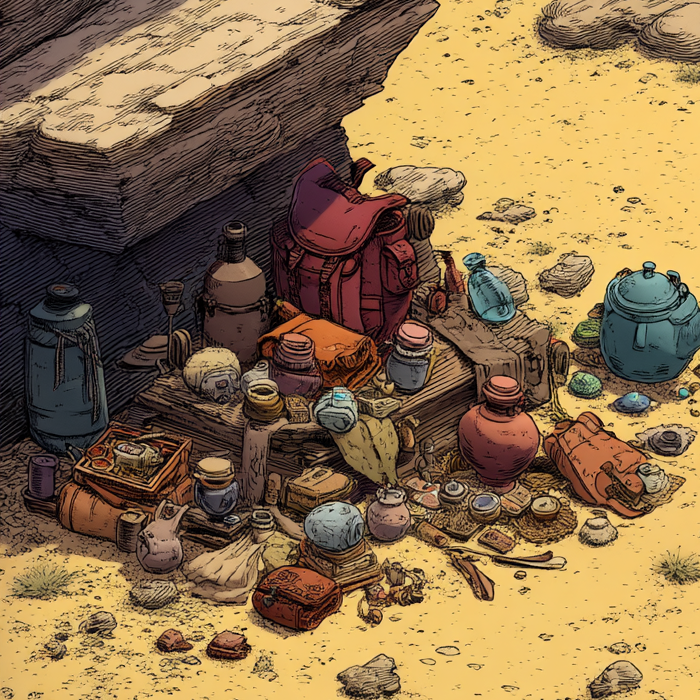
Tarisia is a world ravaged by extreme weather, harsh flora and fauna, and constantly warring city-states. Due to the extreme rarity of metal, including gold, there is no universal form of currency between cities and treasure hordes are exceptionally rare. In fact, several cities operate completely on a barter system for trade and water is the most valuable asset across Tarisia.
To represent this abstraction of wealth, and the vital importance of supplies like water and food, Sands of Tarisia uses a the Caches system detailed below.
Surviving Tarisia
At GM discretion, such as during extreme weather events or long periods of travel, and at the beginning of any session occurring outside of the comforts of civilization, the player tests Survival1, utilizing Caches as they see fit. The character suffers a Fatigue on failure, due to the brutality of the Tarisians desert. This can incapacitate a character, and players may spend Hope to reroll this test, as normal.
Caches Die
Every player character starts with a Caches Die representing the food, water, dry goods, local currencies, small treasures, and tradable miscellany they carry. That die begins at d4, but will fluctuate up and down as they gain and spend (or lose) various supplies. It can only be d4–2 at the lowest, and d12 at the highest.
A player will use their Caches Die when bartering for goods to represent the value of various items and currencies they possess, but they may also use it to aid in surviving the harsh conditions and extreme weather of Tarisia. If a sandstorm descends on the characters suddenly, or the party has been traveling for weeks in the Endless Dunes, they’ll need the provisions in their Caches to make it out alive.
Encumbrance
Having a high Caches die comes at a cost. All of the rations, water, and tradable items carried have significant weight. If your Caches die exceeds your Strength die, your character becomes Encumbered1, and if your Caches die exceeds your Strength by more than two die types it’s considered 3x the lifted weight per the Encumbrance rules in SWADE.
Some Edges, Mounts, or beasts of burden, will increase the amount characters can carry before suffering Encumbrance. Players may also choose to abandon Caches by lowering their Provisions Die at any time.
Stored Caches
Heroes may store Caches for use later, or may stumble upon Stored Caches left behind by past adventurers. These Caches are given a die value equal to the amount of goods kept there, but become vulnerable to discovery, contamination, or infestation.
Upon finding, or retrieving, Stored Caches, heroes, as a group, must roll on the Stored Caches table, adjusting their roll for any modifiers (such as weather having obscured the location, or traps having been set upon the horde.)
Remember the Rule of Cool!
Sometimes you just need your players to find Stored Caches, whether contaminated or not. Let the story take precedent and skip the dice roll!
| d8 | Result |
|---|---|
| ≤ 1 | Looks like maybe some Caches had been here before, but there’s nothing here now. |
| 2 | These appear fine at first, but they’re infested or contaminated, and it’s spread to your own supplies. Gain no increase to your Caches die type, and receive –2 on all Caches rolls until you’re able to purify or replace your supplies. |
| 3 | Someone, or some thing, has found these Caches and pilfered through them. Reduce this Stored Caches die type by 2.2 |
| 4 | Whether bugs, small creatures, Corruption, or the unbearable heat, something has spoiled these Caches. You salvage what you can, reduce this Stored Caches die type by 1.2 |
| 5 | You’re not alone! You’re ambushed trying to retrieve the Caches. Fight for your horde in a simple Dramatic Task1. |
| 6-7 | Thankfully, you find your Caches just as you left them. |
| 8+ | Fortune favors you! You discover more Caches here than expected. Receive a +2 on your next Caches roll. |
Using Caches
Bartering for small items requires no die roll, but more expensive gear ($10 × Caches die type), requires players roll their Caches die. With Success they acquire the item, but with Failure they are unable to find or barter for it. They cannot reattempt the purchase for at least a week of in-game time, or longer at GM’s discretion.
- Success with Raise the character acquires the item(s), and doesn’t lose any Caches.
- Success the character has enough Caches to trade, but doing so dwindles their supplies, reducing their die type by one (e.g. d6 to d4, with lowest being d4–2).
- Failure means they cannot acquire the item.
- Critical Failure means they cannot acquire the item, and realize they’ve lost or used more Caches than they thought. Their die type reduces by one.
Surviving With Caches
Any time a hero makes a survival roll (e.g. to survive a Sandstorm, or endure high temperatures) they may choose to roll their Caches die to gain bonuses to their roll.
- Success with Raise grants +2 and they do not lose a die type.
- Success grants a +1 bonus, but their Caches die reduces one type (e.g. d6 to d4, with lowest being d4–2)
- Failure grants no bonus and they lose a die type as they utilize valuable resources.
- Critical Failure grants –1 penalty, as some of their Caches have spoiled, and they lose a die type.